Saturday, 6 June 2015

Review: Delirium by Lauren Oliver

11614718


Publisher: HarperCollins
Publication Date: 3rd February 2011
Source: Bought (second-hand shop)
Genre: YA Dystopia
Enjoyment Rating: 5 stars
Technical Rating: 3 stars

Summary: In the world of Delirium, love is seen as a disease (amor deliria nervosa), and all citizens undergo a procedure at 18 to remove their capacity for this, the most dangerous emotion - one that kills you both when you have it and when you don't. Lena is about to turn 18 and is looking forward to her procedure - until she meets Alex and begins to uncover the truth.


In short: I adored this book and read it in a day. Writing this review, I've described many, many flaws in the book - but despite that, the writing is phenomenal so I really recommend you buy the book.


There's something that happens to me a lot when I read, especially with dystopia: I wish, I mentally beg the characters not to tamper with the system. Don't mess up your evaluation by coincidentally being reminded of your suspiciously dead mother. Don't ruin your life. I can forgive this with something like The Hunger Games, when life actually is shit and something has to be done. At the very least, find a way to overthrow the system that doesn't involve failing your evaluation. Don't do something stupid while being watched. 


This happened to Lena during her evaluation - the one she's prepared for her whole life - and I had this awful premonition of how things would go, of how she'd have to escape society and leave with the inevitable rebels, and that's what would happen to the plot. Thankfully, the author diverted this fate with a mysterious stampede of cows into the exam center necessitating rescheduling her evaluation. 


I'm a bit suspicious of the fact that the cure can only be given to those over 18. The explanation given in the book is that the brain isn't finished developing until then, but it does seem awfully convenient that this allows teenage love, which is what sells a lot of YA. I could accept this with freida from Only Ever Yours by Louise O' Neill as freida has been systematically abused from birth, but Lena has actually suffered relatively little trauma amongst other YA dystopian characters.


Lena is pretty pathetic and very standard YA. She literally describes herself as plain all the time, acts as if Alex makes her whole, and has a character arc identical to far too many other YA heroines (finally finding courage and leaving the society). Despite that, I'm fine reading through her perspective - I just don't like her as a person. 


Other flaws: It's not quite as disturbing as it could be - I feel like that could've been explored a lot more. There weren't many moments where I had the dawning horror I had in, say, The Giver as I realised the implications of something, although I still enjoyed Delirium more. There were plenty of chilling moments, but they weren't given the treatment they deserved, I feel. The characters are also idiots and I feel like the book underestimates teenagers - Lena really believes that Romeo and Juliet is beautiful (in contrast to the society, which says it's a cautionary tale). We're supposed to believe Lena when she says this, which is just stupid. Also, Lena doesn't know what poetry is at all - as in, she's never heard the word - which seems a bit unrealistic.


The juxtaposition of religion and science (the three founding pillars of the society are God, Science and Order) was quite interesting, although it was concerning to see that the whole society is Creationist. There was a bit of that dumb YA naming, i.e. being gay is called "Unnaturalism", which is pretty clunky.


There were some very annoying consistency errors. Near the start of the book, Lena, who is terrified of love and being infected, says "I love children". Not even as a secret: she says this out loud, and it's perfectly accepted. I can accept loving photography or something, maybe you can get away with that - but the whole point is that you're not allowed love children. That's what causes the "occasional" cases of detachment, where mothers sit on their child's windpipe or leave them to starve (viscerally disturbing detail right there). Another unrealistic thing is after Alex rescues Lena from a raid on a house party - she's been bitten badly by a police dog, so he takes of his top and ties it around her leg to stop the bleeding. Okay so far, if a bit provocative. Then they start making out right there in the shed, when the raid could still be going on for all they know. They could literally be executed for that offence, but suddenly they don't care. Cautious Lena must have had a complete personality transplant, no lobotomy required. Maybe there is some merit to the belief that amor deliria nervosa is a legitimate disease. 


When Lena needs to contact people, why doesn't she just text them? We see her texting Hana about something mundane late in the book, so why doesn't she text to warn her instead off running out into a raid to save her? I know the censors are watching, but it wouldn't be that hard to send coded messages. 


I found it weird that for a lot of the book, catching the disease is treated as a crime. If the society actually believed love was a disease, wouldn't they be kind to the sufferers and get them treated humanely? 


There wasn't really any convincing explanation for how deliria is contagious. I think the author could at least have made up some government "science" that gives a plausible mechanism for the disease. Oxytocin is raised when you love someone, right? So - just spitballing here - the government could tell people that too much oxytocin was toxic, and that's why amor deliria nervosa eventually causes death. 

BUT


I still loved the book, so let's look at some of the reasons for that.


First of all, the writing was exquisite. It's a long book, somewhere around 400 pages, but I was carried along easily by Oliver's gorgeous prose. I'm not sure what else I can say about it, just that she has a wonderful way with words.


I love Alex. I'm not going to examine him too closely in case that stops, but 10/10, I would. Thankfully, there was no love triangle like there was in Matched, an otherwise quite similar book. 


I love the start of chapters. They all start with a quote from some official document, like the government archive of banned words and phrases, excerpts from The Book of Shhh (short for Health and other similar words) and children's nursery rhymes. I particularly liked this one: 


Mama, Mama, help me get home

I'm out in the woods, I am out on my own
I found me a werewolf, a nasty old mutt
It showed me its teeth and went straight for my gut

Mama, Mama, help me get home

I'm out in the woods, I am out on my own
I was stopped by a vampire, a rotting old wreck
It showed me its fangs, and went straight for my neck

Mama, Mama, put me to bed

I won't make it home, I'm already half-dead
I met an Invalid, and fell for his art
He showed me his smile, and went straight for my heart.

Chilling, isn't it? Invalids is the name for the uncureds who live outside city boundaries. Interesting name for how it bucks the trends of YA - the rebels are usually physically stronger, and these ones probably are, but they're called sick. Freedom is sickness.


I did like Lena's relationship with Gracie, her little sister who everyone else thinks is mute. Hana, her best friend, was also cool to read about, although their friendship seems a bit unhealthy. 


I'm really annoyed at it being a series. I realised about ten minutes before I finished the book that I'd heard it was a trilogy, and that really pissed me off. Doubt I'll be able to get the other two from a second-hand shop.

The ending was a heartbreaking cliffhanger, but I cling to the hope that my favourite character will be okay by the end of Requiem. Thrilling conclusion.

Removed from the book, I can point out all these flaws. And while I could see them while reading and they did occasionally disrupt my reading experience, I still adored reading Delirium. 


Other Reviews:

Recovering Potter Addict
Blogcritics
Dear Author

Sunday, 10 May 2015

Review: Black Hole Focus by Isaiah Hankel

21500669

Publisher: Capstone (Wiley)
Publication Date: May 5th 2014
Genre: Self-Help
Source: Free at Conference
Rating: 2.5 stars

Blurb: 

Create your purpose. Change your life.

Don't get stuck on a path you have no passion for. Don't waste your intelligence on something that doesn't excite or motivate you. Let Isaiah Hankel help you define a focus so powerful that everything in your life will be pulled towards it.

Be focused. Be fulfilled. Be successful.

It's time to take control and think about your strategy for life. Whatever experience or qualifications you have right now, you can start living purposefully today.

Doctor and Fortune 500 consultant Isaiah Hankel is an internationally recognized expert in the biotecholnology industry and specializes in helping people transition out of unfulfilling jobs onto cutting-edge career tracks. 

In Black Hole Focus, Isaiah shows you how to hone your purpose so that everything you do stays true to that ultimate focus. You will discover why you need a purpose, how to find it and then crucially how to fulfill that purpose and get all that you deserve in life.

Escape the things you hate in life - and get everything you've ever wanted.


2.5 seems a mean rating, but I'm trying to stop inflating my ratings. 

So, this is - I think - the first self-help book I've ever read. In my defence, it was free, and I don't waste free things if I can help it. 


The author pitches well to his audience's egos - 99% of the people at this conference had PhDs, so he sucks up to them saying "Personal Development for Smart People". If you want people to buy things, make it about them.

So, what did I think of the book? It started off well, and I liked the story about how he got to this place. It went downhill about a third of the way through, though, and got very unoriginal. I haven't even read other self-help books, and I've still heard a lot of this stuff before. Isaiah's style is pretty motivational, but seeing as I could replicate that myself I wasn't too impressed. The case studies annoyed me most of the time - they seemed very artificial.

All that said, I did love some parts. Here's what I highlighted.

"Once your amygdala finds negative information, it immediately transfers this information into your long-term memory ... Positive experiences have to be held in awareness for more than twelve seconds in order for your brain to transfer them from your short-term to long-term memory banks. This is why most people instantly forget praises, but can remember a single criticism for years."

I liked this, because it was an interesting explanation and rang true. It saddens me that I can't remember compliments. Another thing I've noticed is that I never ever notice or remember people applauding when I leave stages, even though I'm sure they're doing it. My brain, high on adrenaline, just blocks it out.

Another part I liked was when he talked about how he would always run faster in athletics when his coach shouted "Last one, give everything." This isn't really a surprise - of course you're going to give more when you know how many are left. But it was presented well in the book, so kudos for that. He extrapolated from this to say "Defining the path in front of you will give you the energy you need to complete it."

He then had a chapter saying the end is where we start from. I loved the story about Jim Carrey, then broke and jobless, writing himself a check for $10 million, dated for eight years into the future. Seven years later, he discovered his pay for the movie Dumb & Dumber was $10 million.

Now, stories like these tend to set alarms ringing in my head by how perfectly coincidental they are. But it was still nice to read. 

There was also some good writing advice: "the best way to write a script is to construct a plot by writing backwards from the climax, using reverse cause and effect."

Something that hit me fairly hard was about the pointlessness of to-do lists and constantly chasing the next achievement - that's, according to the book, "tactician" behaviour, when you should be going for "strategist". 

There was also this quote from Tim Ferriss: "It's lonely at the top. Ninety-nine percent of people in this world are convinced they are incapable of achieving great things, so they aim for the mediocre. The level of competition is thus fiercest for "realistic" goals, paradoxically making them the most time- and energy-consuming."

The author is not a fan of uni labs, saying "all the post-docs and assistant professors I knew lived in 10-foot by 10-foot prison cells called labs, repeating experiments and writing grant proposals that failed to get funded 93% of the time."

This is a bit discouraging, Isaiah. Screw you. Ah well, I know I'm going to have to change academia up a bit anyway. 

He recommended writing down the position you want, and said that what you fear writing the most is often what you want the most. 

I loved this bit: "The Pygmalion effect is a phenomenon where the greater the expectation placed on a person, the better he or she performs." I've definitely noticed this in my own life, and it's exactly why I put so much pressure on myself - because I know I can do it. I usually only fail to do things because I don't set proper goals, and that is from me, not some self-help book. 

So - was reading the book worthwhile? I guess so. It's always good to read, and non-fiction broadens the mind. There were certainly some interesting points - I just got sick of him going on about things that only apply to adults.

When oh when will a book have me as its target audience?

Monday, 13 April 2015

Review: Across the Universe by Beth Revis

Publisher: Razorbill
Pub Date: 11/01/2011
Genre: YA science fiction
Pages: 398
Rating: 3.5

Blurb: 
A love out of time. A spaceship built of secrets and murder. 

Seventeen-year-old Amy joins her parents as frozen cargo aboard the vast spaceship Godspeed and expects to awaken on a new planet, three hundred years in the future. Never could she have known that her frozen slumber would come to an end fifty years too soon and that she would be thrust into the brave new world of a spaceship that lives by its own rules.

Amy quickly realizes that her awakening was no mere computer malfunction. Someone - one of the few thousand inhabitants of the spaceship - tried to kill her. And if Amy doesn't do something soon, her parents will be next.

Now Amy must race to unlock Godspeed's hidden secrets. But out of her list of murder suspects, there's only one who matters: Elder, the future leader of the ship and the love she could never have seen coming.


I've been waiting to read this book for ages, after seeing Aylee recommend it over at Recovering Potter Addict years ago. This one I went into knowing it’s a trilogy, even though I’m so, so sick of series and trilogies in particular. I think it’s similar to downloadable content for gamers – I don’t want to pay extra just to finish the story. Of course, this depends – something like Harry Potter or The Hunger Games couldn’t really have been in one book, but a lot of YA books suffer from second-book syndrome, where nothing happens in the second book of the trilogy because it’s essentially just a placeholder.

Anyway, it remains to be seen whether that’s the case with the next two books of this trilogy, so I’ll just focus on the one I’ve actually read for now. That would probably help.

OKAY.

So, seventeen-year-old Amy’s parents are boarding a generation ship, which is heading on a 300-year interstellar voyage to Centauri-Earth for some reason. Her father is sixth-in-command of the military, and her mother is a bioengineer, so those two are essential for the mission. She decides to accompany them even though she’s “non-essential”, so is flash-frozen alongside them and put into the ship, Godspeed to sleep through the next 300 years.

But she’s woken up by an attempted murder 250 years later and defrosted. She can’t go back to sleep or she might never wake up, so she’s on the strange ship without anyone she knew. Only – surprise! – since this is a generation ship, there are (I think) 2,312 people living and reproducing there. She makes friends with the leader-in-training, Elder, and his friend and painter, Harley.

Then lots of shenanigans happen and many secrets are revealed.

The story is told in first-person, rotating between Elder and Amy every second chapter. It’s interesting to see their different perspectives, and the secrets they keep from each other.

I’m not entirely sure how I feel about Across the Universe. The world-building is very impressive, but still lacking in some ways (e.g. I still don’t know why the ship left Earth).

It’s way too YA-romantic, with insta-love and everything. I could’ve done without the romance.

Still, there’s an entire world inside that ship, and good explanations are offered for everything. The secrets are interesting, but only one of them made me physically react – maybe I wasn’t bonded enough to the characters. There’s a sense of the universe’s apathy, as sad things happen without reason. Also, if you’re sensitive about rape or suicide, you may want to give this one a miss. But that’s not really a spoiler, and the two topics are approached in unique ways that made them fascinating (though sad) to read about.

Themes of filial piety, destiny and coming of age are explored, all coalescing in the last couple of scenes. I’m having difficulty explaining why, but I felt like it was sort of Shakespearian, the climactic scene. I guess it makes sense, since the author is an English teacher. Just like with the last book I reviewed though (If I Stay) I was dissatisfied with the ending. I’m not as angry with this one as I was with the last one, because it was a lot longer so that cushions the fall, but the ending was still fairly open.

Also, THERE WERE NO PAGE NUMBERS. Now, this could just have been in my edition, but that makes me mad. How was I supposed to remember where I was if I left the book down? Hey, maybe it was a ploy to make the book unputdownable.


Still. I didn’t quite form attachments as deep as I would’ve liked to the characters, and it just feels like there was something lacking. But I will probably read the sequels, and I have to admit that it’s an impressive and imaginative book. 

Monday, 6 April 2015

Review: If I Stay by Gayle Forman

Publisher: Speak
Pub Date: 01/01/09
Genre: YA Contemporary
Pages: 210
Rating: 3.5 

Blurb:
On a day that started like any other, Mia had everything: a loving family, a gorgeous, admiring boyfriend, and a bright future full of music and full of choices.

 In an instant, almost all of that is taken from her. Caught between life and death, between a happy past and an unknowable future, Mia spends one critical day contemplating the only decision she has left. It is the most important decision she'll ever make.

Simultaneously tragic and hopeful, this is a romantic, riveting, and ultimately uplifting story about memory, music, living, dying, loving.


This review could’ve been different. It didn’t have to be this way.

I was really enjoying If I Stay by Gayle Forman. The writing was exquisite, the characters unique, and I was driven close to tears at points. I was so engaged, compelled to wonder what would happen next and how the narrator’s dilemma would be resolved.

And then the author screwed me over.

Let me backtrack a bit.

So, teenage cellist Mia is on a snowy drive with her parents and little brother when a truck crashes into them. The parents die instantly, and she and her brother Teddy are taken to hospital in critical condition. Mia is in a coma, but her spirit/ghost/soul is aware and follows her body around, though she can’t interact with the world. I guess that’s comforting for those with friends in a coma.

The whole story takes place over a couple of days with a lot of flashbacks and introspection, so most of the action is Mia’s body having various operations and panic stations, and all the people she knows coming in to talk to her and ask her to come out of the coma. Mia’s spirit can wander wherever, so she sees her best friend Kim and boyfriend Adam planning ways to break into the ward and sees the outside world that way.

I really liked the flashbacks. With that short a timeframe, they were necessary to have a book-length work (more on that later). They mostly focus on her boyfriend, her family and music (specifically the cello and her growing proficiency at it as she picks it up as a kid, then goes to classical music summer camps – while Kim is at Jewish camp – and finally auditions for Juilliard). Hang on, I just realised that if she survives, she might be so mangled she’ll be unable to go to Juilliard. That’s sad.

She has a really good relationship with her parents (maybe a bit unrealistic, but nice to read). Her parents both used to be rockers, but her mother is now a housewife and her father an English teacher. We see another iteration of Ditzy Father Syndrome – he didn’t learn to drive until the second child (Teddy). It is a charming family, though.

Anyway, soon enough after the accident, she realises that this spirit of hers has the power to decide whether or not she stays. She weighs up the options – live with her friends but as an orphan, or die with her family? There’s a very touching moment nearish the end where Kim whispers to her that all her friends and non-immediate relatives are waiting downstairs and that “You still have a family.” We see her being swayed different ways by hearing different people talking, and this really got me thinking and seriously trying to figure out what she should do given the available – well, not evidence, but information. Sort of like an emotional detective story.

Here’s where the screwing over comes in. When I’m really enjoying a book but I’m nearing a bit where I’m afraid the author might choose to end it, I take a quick look to see how many pages are left. I was reassured here because there was around a fifth of the book left … and then I turned the page and it said THE END.

You know what was behind that page? Acknowledgements! And background information like the reasoning behind music choices, which I was too insulted to read! For like forty pages! I’d expect to see that sort of thing in fanfiction, not in a published novel.

What had just happened was what might happen 60% of the way through a novel, going by classic techniques or whatever. A sign of hope that doesn’t give away the ending.

It’s absolutely inappropriate for an actual ending!

The book is a measly 210 pages, and the worst part is that the story isn’t even remotely finished. Even as a reader, I could say (broadly) what should happen next.

Oh, and surprise surprise – there’s a sequel. A sequel called Where She Went. Okay, not only is that a massive spoiler, it’s totally inaccurate and doesn’t follow the first book, which is – I’m pretty sure – the entire point of a sequel.
Then again, it’d be difficult to follow the total non-ending of that book.

Look, it might not be the author’s fault. The writing was beautiful, and it does seem like something a publisher might choose to do for commercial purposes (especially going by the movie). But I can’t think of anything that could’ve happened in the book that would have pissed me off more.

Wednesday, 18 March 2015

Review: Geek Girl by Holly Smale


Publisher: HarperCollins
Published: 2013
Pages: 387
Genre: Contemporary
Source: Library
Rating: 4/5
Blurb:
Harriet Manners knows a lot of facts.
·         Humans have 70,000 thoughts per day.
·         Caterpillars have four thousand muscles.
·         The average person eats a ton of food in a year.
·         Being a Geek + Model = a whole new set of graffiti on your belongings. But clearly she knows nothing about boys. And on a whirlwind modelling trip to Tokyo, Harriet would trade in everything she’s ever learnt for just the faintest idea of what to do next.

I read Geek Girl, the first in this series, a few months ago, and checked this one out of the library recently (it’s probably overdue now. Sorry, library). You can read my review of that here.
As you can probably tell from my very slow updating of this blog, I haven’t been reading much lately. Well, I’ve been reading, but I haven’t been finishing books – I have about four currently on the go. But just over a week ago, my internet went, and I won’t have it back for another week, so … I have a lot more time. I’m also super frustrated and unproductive without internet, and forced to cart my laptop to school, but still.

Back on topic.

I’m not going to bother with a spoiler warning for the first book because there’s not much to spoil. However, there are some delicious twists towards the end of this one (the second book in the series), so I’m not going to spoil those. It should be safe to read on.

Right, so the annoyances I had with the last book mostly remain. The stupid geek facts, for example – someone who knows a lot of trivia isn’t the only kind of geek, though I prefer to say nerd.  The very simple formulae that plaster the book cover just to give the impression of being smart.
They’re inside the book too. In an early chapter, she’s at a photoshoot when suddenly, shock horror, the photographer discovers that she’s stuck physics formulae all over her arm/shoe sole/ inside of jacket so she can study while modelling.

The formulae are:

“F = M x A”
“V = I x R”
“Ek = ½ x M x V2”
“W = M x G”

Now, not only are these all ridiculously simple formulae, they’re written in such a horrifically inefficient way. Also, I’m just going to give you the notation because I can. V = I x R I haven’t covered this year, but I *think* I know it.

F = ma means force is mass by acceleration. V = IR means voltage is current by resistance. Ek = ½ mv2 means kinetic energy is half of mass by velocity squared (V2? Ugh). W = mg is mass by acceleration due to gravity, and I like this one because it fits exactly into F = ma (weight is force of gravity on an object, g is a type of acceleration).

 Other things that annoy me:
The astonishingly unlikely plot.

The fact that Harriet’s priorities are absolutely all over the place, and she seems to possess no maturity or common sense whatsoever. Like, a certain level of ditziness is cute, but this is just ridiculous. And she goes around saying she’s such a geek when the back of the book says her main problem is not knowing how to interact with boys. I mean, seriously? The blurb then goes on to say that she’d trade all her knowledge – which, may I remind you, is essentially her entire sense of self – to know how to handle boys and social life while in Tokyo.

Please get some nerd integrity.

The stalker – stalking is still condoned by the author. Toby is sweet, but he is still a stalker.

She obsesses over a boy for the entire book. I don’t understand people who do this, fictional or real.

They’re just one person! Don’t base your entire life around them!

So why the four stars then? Well, first you have to bear in mind that my rating systems are based on gut feeling, and despite the peeves I did really enjoy this book.

The humour can be Big-Bang-Theory-forced, but it’s still funny. Like, just after the irritating Physics formulae, there’s this:

‘”Harriet Manners, are you studying maths in the middle of my fashion shoot?”
I shake my head and look at the air above the photographer’s left ear. You know the crocodile and the bird? I think one of us is about to get eaten.
“No,” I answer in my littlest voice. Because a) It’s physics, and b) I’ve been doing it all the way through.” ‘

I think that quote captures Harriet’s character voice well. Also, why is she called Harriet?

The things I loved from the first book also stayed the same. I love Annabel, and Harriet’s silly Dad (there’s a quote I can’t find where her dad says something like “I’m afraid all the female Pants are Smarty in this house”, and he texts Harriet while she’s in Japan asking can he eat her chocolate. They’re very close and it’s sweet.

The modelling world described (e.g. the crazy designer Yuka Ito) is so much fun to read about, so it’s a rare contemporary that still has a surprising and intriguing setting. The author skilfully sets up lots of scenarios, building towards climaxes at different points in a textbook sort of way (you know, “Complication 1” “Complication 2” “Black Moment”). I know a story needs conflict, but I felt that thing again where I just want a character to gallivant in this cool new setting without running into problems when of course they inevitably can’t.

Holly Smale is really good at creating distinct characters, although I fear some may just be stereotypes (Wilbur is stereotypically gay and Rin is stereotypically Japanese/Asian/kawaii). Then again, the author lived in Japan for two years and I don’t actually know any Japanese girls (I don’t think?) so maybe. They’re very entertaining on the page, anyway.

My favourite part of this book, and the part that definitely pushed it up to four stars, was all the twists. Obviously I can’t go into detail without spoiling, but I definitely got some surprises.
I didn’t particularly like the resolution. Harriet makes a mature decision, much like the one Cath makes (off-screen) in Fangirl, and though I know it’s necessary for her character arc, it promises an end to a lot of what I found entertaining. Then again, there’s a whole third book to read, so there should be lots more in store.


Saturday, 17 January 2015

Review: The Dying of the Light (Skulduggery Pleasant #9) by Derek Landy (SPOILERS)

  SPOILER SPOILER  SPOILER  
SPOILER SPOILER SPOILER 
SPOILER SPOILER SPOILER
 SPOILER SPOILER SPOILER 

Okay, that's enough spoiler warnings. I've never had to put a spoiler warning in the title before. This is going to be a really hard review to write, and I can't do it justice without spoilers. So there are going to be spoilers for the whole series from here on out.


This review might not be entirely coherent, but it'll be cathartic.


------


18131799

Publisher: HarperCollins Children's
Date of Publication: August 28th 2014
Pages: 605
Source: Christmas present
Rating: ?????

I'm so disappointed. As a whole, the book was thrilling and emotional and everything we expect a Skulduggery Pleasant book to be (almost), but I'm so upset by the ending. 


The book starts with some weird chapter from the perspective of this randomer called Danny living a boring, ordinary life in Meek Ridge. Periodically, he brings groceries to a girl called Stephanie who lives all alone in a mansion. The name is supposed to ring a bell with us (and it does, obviously) but we don't understand it. This subplot continues through the book, with Danny at one point being kidnapped as two killers chase Stephanie. The Danny chapters are just sprinkled throughout, and I hated them because I didn't care in the slightest about Danny or this mysterious Stephanie. 


All I wanted was Valkyrie's perspective.


For the majority of the book, that is not what I got. 


At the end of LSoDM, Darquesse took over Valkyrie. So for a large chunk at the start of the book, we get Stephanie's perspective. Skulduggery is sullen because he's lost his partner, and while this is entirely understandable I missed his wit. I really dislike the dark turn the last two books took. I mean, SP has always been gory, and that was okay. But there are all these real war casualties, and it's so sad. Then again, I'm glad I properly grew up with these books. The Harry Potter books are very special to me, but I pretty much missed the Hogwarts express, or only caught the tail end. The first book came out shortly before I was born, and so I read Fred's death when I was eight or nine so I didn't really get the emotional impact. 


I'm getting the emotional impact here.


And that's why I'm so annoyed with how Derek toyed with it. 


TV Tropes just told me Argeddion died. Fucking Argeddion, and I'd forgotten it, because there were too many other deaths. 


TV tropes also says Skulduggery beat Darquesse and Argeddion in LSoDM by giving them epileptic fits. I don't remember half of this stuff. I really need to re-read the books. 


I think I understand why Derek gave us Stephanie's perspective. It was really awkward for the characters because they had to sort out in their heads that she's now her own person, but that makes it awkward for the reader too. Derek probably liked that, but I didn't need that particular complication while reading through everything else in the million subplots. The book mentions her killing Carol, but that line isn't resolved at all. She's not even punished for it, as far as I can remember. I'm so mad. 


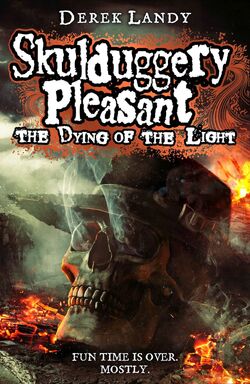
I was pretty apprehensive when I saw the cover (the titular character's skull is on the ground, burning), but that particular reality doesn't come to pass, as far as I know.


A plainly ridiculous amount of stuff happens in this book, and it's impossible to go through it all. I know I said there'd be spoilers here, but honestly describing the book would just be "x dies, comes back to life, dies again, y dies, z dies horribly, a betrays b, everyone dies". 


I get that the chapters were an artistic choice, but I hated them. I mean, I got the point later on in the book when they were just one line, but Derek would end chapters in the middle of a sentence and then finish that sentence in a new chapter in a different character's perspective. I shudder to think of how much editing this book must have needed. 


A ton of characters are brought back from the previous books to deal with Darquesse. It's really great to see Fletcher, who I love, but then you also have, let's think ... Wreath, Melancholia, Vile, vampires, Cassandra & Finbar (who have a surprisingly huge role after just turning up), the Dead Men, Billy-Ray Sanguine, Tanith, Mevolent, Serpine and more.


Tanith finally loses her Remnant, thanks to Darquesse. Darquesse has become really annoying in this book; rather than being playful and crazy with her power like in the previous books, she's now studying weird and arcane magic, trying to become The Most Powerful of All. Whereas in Death Bringer she and Lord Vile were pretty evenly matched, she goes up against Vile and Melancholia together and literally blasts both of them out of the park. 

I loved Scapegrace, Thrasher and Clarabelle's subplot. They're one group that has been consistently funny all through the series, and I'm so glad they get a happy ending. 

Valkyrie loses her magic partway through the book in a gutwrenching twist, but then we have yet another reversal and she gets her surge, giving her some weird, unsatisfying magic where she blasts beams of energy through her hands (but she's not an Energy-Thrower). So we don't get any of that Elemental good stuff or the cool/scary Necromancy. I'll admit, her heartbreak at losing her magic was one of the few twists I did appreciate (though it pained me).

I also quite liked the failure of the plan to suck Darquesse out of Valkyrie, because Darquesse goes along with it and actually has a moment where she considers being good. She also has a pretty awesome fight seen with what I'm remembering as a giant dog impervious to magic, which Valkyrie definitely wouldn't have survived. The fear on people's faces when they realise she's Darquesse is pretty great too. I also liked how Stephanie and Valkyrie have to deal with dirty looks because they look the same as Darquesse.

Then again, I've never really understood how Valkyrie always gets forgiven after Darquesse goes on a rampage. They may have different names, but Darquesse is Val's true name, remember? It's just uncomfortable to think that's who she really is. 

Look, I probably would have liked the book if not for that stupid ending. Everyone's losing in the fight to Darquesse, and then she kills them all gruesomely, including Val, Skul, Fletcher, everyone. She then torches the rest of the world, and flies off into the solar system, then into other universes, where she's bored so she solves quantum mechanics (I'm not kidding). I was sitting reading it with a friend and I didn't even consider that a spoiler because it's so bloody ridiculous.

And then we find out, oops, it was a dream organised by the psychics, Darquesse has now sent herself through a portal into the land of the Faceless Ones, everyone is alive (well, the few who were alive before this scene.)

Not only is that cheating, the conclusion of the Danny arc is so important and I hate it. It turns out the reason it's written in present tense is that it's set in the future. Val fights a random bad guy in a stupid, unsatisfying fight scene, and once she's rescued a mortal, it turns out she's been telling him this whole story.

Seriously. That's why the series is from her perspective. She's been telling some irrelevant mortal called Danny. It's extra-annoying because it shows that there's been no great conclusion; Val is still fighting run-of-the-mill bad guys, which is a bit of a let-down from Faceless Ones and Darquesse. 

Skulduggery pulls off a last-minute twist by (instead of sacrificing himself, like we thought he would), throwing Ravel into the Accelerator to save the world (again). It's a very Skulduggery thing to do, yes, but still.

After this it's just Val reminiscing to Danny. We learn she's been living in America for five years, taking time out, and don't know if she ever talks to Skulduggery or any other character we know and love. She just leaves it all behind. It reminds me of the ending of Fangirl; she's matured, but it's so unsatisfying and I'm not ready to mature that much with her.

Only, SP matters so much more to me than Fangirl because I grew up with it. I'm so disappointed it missed the mark on this one, but I will always love the series. Especially Death Bringer. Now that's the Darquesse I like. 

And there's always fanfiction.

Friday, 26 December 2014

Christmas Book Haul 2014!

This Christmas I got six books (and let's face it, I'm going to "borrow" some of my brothers' ones, because they have tons. The 7-year-old got like 17 from Santa.) At the moment I'm "borrowing" The Knife of Never Letting Go from my 7-year-old brother. Anyway.

Here's what I got from Mam. Just one book and it's historical fiction which I don't usually read, but sure I'll give it a go. My sister got me a gorgeous notebook too, and I LOVE notebooks. 


This is everything I got from my Dad. It pretty much exactly matches what I asked for, which is predictable but cool.

I also have the books I bought secondhand a while ago (already blogged about), plus my brothers', which include The Knife of Never Letting Go, Bad Science by Ben Goldacre (think I've read it before, but it's worth another re-read, it's pretty funny) and the entire Series of Unfortunate Events. I probably won't be reading that last one, but when you add in the review books I have (if they ever download properly), I'll have tons to read over Christmas. 

The Dying of the Light Cover

I've been waiting for this book FOREVER. Well, okay, since late August, but whatever. I'm on page 51 right now and apprehensive to see how the series will end. It's not encouraging that the cover has the protagonist's skull on a bonfire, but hopefully it's just Derek messing with us. 

17607716


This is the final book in Dan Wells' Partials trilogy (you can read my reviews of the first two, Partials and Fragments here and here). It's been so long since I read Fragments and unfortunately I got it as an e-ARC so I can't reread it, but hopefully going back over the reviews will help. Anyway, I adored Fragments so I'm looking forward to this.

13389182

Another sequel to a book I adored (and reviewed), this is the second book in the Daughter of Smoke and Bone series. It's lucky I have Christmas and people to buy gifts for me, because otherwise I'd never bother to buy sequels. Anyway, this has phenomenal writing, stunning twists and an original plot, and I can't wait to get back to it.


8235178


Finally, the start of a series rather than a sequel! I've wanted this since I read a review by Aylee, and I finally have it. The plot seems compelling, and I really should read some hard sci-fi if I profess to be such a sci-fi fan. 


4374400


Honesty time: I got this because of the film that came out recently, because I didn't really know it existed before. I saw a Tumblr gifset of her boyfriend talking to her and it was just so adorable ... I'm only human, okay? I did find a pirated copy on the internet accidentally (I swear) but it's all good because it's been properly paid for now and I only read a couple of pages. I really dislike the apparent spoiler in the TITLE of the second book (Where She Went). I mean, honestly. Don't ruin it in the title. 


6499452


The book Mam got me is historical fiction about Lady Elizabeth, Henry VIII's daughter. It's not top of my priority list, but here's hoping it'll be an unexpected gem. 


I "borrowed" my brother's The Knife of Never Letting Go (don't worry, he's fine with it). I'll be honest, it's not really my thing so far. I can't stand phonetic spelling (at least there's only a little - it was AWFUL with Blood Red Road, I couldn't finish that one). But I'm two chapters in and I'll read it after Skulduggery Pleasant: TDOTL, if just because of all the rave reviews. 


Have any of you read these? Feel free to comment below with your Christmas book hauls

Friday, 19 December 2014

Review: Foster by Claire Keegan

8143909
A small girl is sent to live with foster parents on a farm in rural Ireland, without knowing when she will return home. In the strangers’ house, she finds a warmth and affection she has not known before and slowly begins to blossom in their care. And then a secret is revealed and suddenly, she realizes how fragile her idyll is.

Publisher: Faber & Faber
Pages: 89
Rating: 2 Stars
Source: Borrowed

Given to me by my English teacher, on the recommendation that it won some book prize worth 100,000 euro or something. The rating is especially subjective with this one.

In Short: A prizewinner that I just didn't 'get'. At least, I assume so.

thoughts:

There isn't an awful lot to say. Foster is written from the POV of  a child, so Keegan has an excuse to do that thing literary writers love to do, as in write in a painfully innocent, astute way. I do it too, sometimes. But I'm convinced no kid is actually like that, it just looks impressive in a novel (and reads beautifully, yes). 

Keegan is very good at painting pictures using few words (and she'd want to be - the book is under 100 pages). She also captures rural Irish accents very well, though they're really rural, i.e. "bogger" accents, and I'm afraid outsiders (mainly Americans) will think all Irish people speak like that. I like the sense of love she communicates between the Kinsellas and the child (who is never named, as far as I can remember). You do see the relationship dynamics clearly, and the author chooses her words well (unlike me).

The low rating is because I just didn't get it. There's something that happens in the middle that sounds like it'll start an adventure, or at least be a mystery to solve, but it's never mentioned again. There is no exciting plot, it's all just nicely-described mundanity. The ending is far too ambiguous for my tastes, and I left feeling unsatisfied.

I also felt misled by the blurb; the "secret" isn't that big, and certainly doesn't threaten her "fragile idyll". With the great description and use of language, I can see why English teachers would love it, but it didn't engage me in the slightest.

Another example of literary novels not being for me.

I'll probably reread it at some point; hopefully I'll see more then. 

Saturday, 13 December 2014

Thoughts: The Maleficent Seven - Derek Landy

This isn't a review as such, because I can't give any semblance of impartiality. Like I said in my YA vs. Adult post, I grew up with these books. So I finally got around to reading The Maleficent Seven and loved it. I've been trying to find time to read more and that was just the ticket (which suits, because I read it on a train. Get it? Ticket? I'll stop now.)

16119044


This time, the bad guys take the stage. 

Tanith Low, now possessed by a remnant, recruits a gang of villains - many of whom will be familiar from previous Skulduggery adventures - in order to track down and steal the four God-Killer level weapons that could hurt Darquesse when she eventually emerges. Also on the trail of the weapons is a secret group of Sanctuary sorcerors, and doing his best to keep up and keep Tanith alive is one Mr. Ghastly Bespoke.

When the villains around her are lying and scheming and plotting, Tanith needs to stay two steps ahead of her teammates and her enemies. After all, she's get her own double-crosses to plan - and she's a villain herself...

This wasn't the only time I rooted for the bad-guy protagonist, but it was definitely the most fun. I laughed out loud several times while reading it, and the rest of the time just had this stupid smile on my face. Every character is hilarious. All of them, even if it's unintentional. Even though they're all either sarcastic and witty or pathetic and laughable, the characters are still so well-defined and individual. It does help that Derek had seven books before this to flesh out these characters in a more detached way - I think that when you write from the perspective of a character they become more like you, so at least Tanith and co. already had their huge personalities from being described at a distance.

To be honest, I got a bit annoyed by Dexter Vex, Saracen Rue, the Monster Hunters, that whole team, stealing screen time from Tanith. I know the Maleficent Seven needed some obstacles to getting what they wanted, but I just loved Tanith's group so much. I think the Dead Men work best when Skulduggery is with them. Also, I loved how the characters lampshaded Saracen's ability (the elusive "he knows things"). It's played with a lot in this book, and we see him in action, but sadly still no explanation.

GOD there were so many bombshells. Not exactly spoilers, more just shocking backstory. So I don't feel too bad posting some of them. Near the start Sanguine's eyes would have done something "had he not scooped them out long ago". I can't be the only one who assumed he'd been born without eyes, or that he'd lost them in his hitman business. Now I want to know why he plucked his own eyes out. Then again, eye gore is the worst.  At one point someone says about Caelan, Valkyrie's vampire ex-boyfriend: "He stalked and he tortured and he murdered every woman he became enamoured with." Valkyrie and Caelan broke it off rather violently in Death Bringer (I think), the outcome worse for him than it was for her, but by that point he was already acting incredibly creepy and definitely stalking her. So you have to wonder what would have happened if he hadn't reached a timely end. Tanith gets a backstory too, which is fun and unexpected.

We're back to my favourite thing about great series: that they have whole world populated with real characters, so there are an infinite amount of stories possible in that world, both for the author and for fanfic writers.

The fact that the book is based on Tanith is interesting, considering that Derek said he planned to kill her off in the first book. I'm very glad he didn't; while she's evil now, she's still lovable. But oh wow, what an asshole. I can't go into detail because of spoilers, but I'll just expand on what it says in the blurb; Tanith does indeed double-cross people, and murder a few people we've come to like.

It's interesting to see how Valkyrie is seen by others. With the book normally told from her teenage perspective, you'd think that the world of sorcerers just constantly talked about her and Skulduggery, and that they're treated with some respect but not like they're the most important people in the universe. Valyrie and Skulduggery are both arrogant (the latter more so) and that tints the story from their perspective. I like to think about how Valkyrie's adolescence influences her view of the magical world, and how it influences the magical world's view of her.

The fact that Valkyrie is only mentioned a few times is also testament to the secondary characters' ability to prop up a story by themselves.

I'd have to say I prefer this book over Kingdom of the Wicked and Last Stand of Dead Men, but maybe not Death Bringer or Skulduggery Pleasant, just because it's so much fun. Definitely recommended if you're a Minion or whatever they're calling themselves these days, but tread carefully if not. You'll still love the jokes, but it's best to read up to Book 7 or 8 first so you have context.

I still haven't read The Dying of the Light. Getting that for Christmas.


Tuesday, 9 December 2014

Explanation of my Genre Preferences, Part I: YA vs Adult

I never explicitly declared this a YA blog, and yet I don't go near adult books for the most part. Here I thought it might be interesting to explore why that is. I'm going to talk about my other genre preferences (particularly, why I prefer sci-fi and dystopian over contemporary, historical and paranormal romance, in general) in a later post. 

1) Why YA is so Great

YA, or Young Adult, isn't so much a genre as a huge category that contains buckets of other genres like the ones I'm going to discuss below (from the historical-adventure Temeraire series by Naomi Novik to sugary contemporary like Fangirl by Rainbow Rowell).  That's why I put this up here, because it kind of encompasses everything else I like. 

There are plenty of reasons why YA is popular, but a few stand out for me. 

I've always found YA more honest, and I'm not exactly sure why. Adults like to say that teenagers are naive, and maybe we are in some things. While this doesn't make us unintelligent, we do often lack life experience (remember, this isn't true for everyone: some people face more hardship in childhood than some adults will in their entire lives). But that naivete gives us a more optimistic outlook on the world, I think, and that's a nice thing to have in a narrator. Obviously teenagers are sarcastic and often quite cynical, but we do have a heart behind all that, I think, a sense of childlike wonder that's not entirely gone. The cynicism just shows through more often because the sting of life's disappointments is still fresh. We haven't had time to develop a thick skin yet. 

Teenagers seem to get more emotionally invested in books. This is awfully stereotypical, but I've found that this is true of teenage girls especially - you just have to look at a few fandoms to see that. So the sense of community and camaraderie both between the reader and the author and between the reader and other readers of that book/series is wonderful and really heart-felt. I'm sure it's nice for the author too, to have someone really connect emotionally with your book. Letters written to YA authors are not uncommon. I think that’s lovely.

YA has a reputation for not being as good as adult/mainstream fiction, for being less respectable – and I kind of love that, because it means it doesn’t have to be highbrow, it can be about the experience without worrying about being literary. That’s not to say YA books can’t be written exquisitely, many are (Daughter of Smoke and Bone is a great example). But it’s more about the emotional connection in my view. That’s why there are – and need to be – so many memorable characters in YA; they carry the story.

I’m sure there are some literary YA novels (The Weight of Water probably counts), but the ones I love are all about character, as mentioned above, and plot. Because there are so many YA books constantly being published, plots have to be enjoyable again and again.

Note that I didn’t say unique. I’m not going to lie. Again because of the YA boom, writers make copies of popular books in the genre (see: almost every YA Paranormal Romance ever post-Twilight), and oh boy do they sell. But that’s because there’s something in the plot or the setup that really strikes a chord with readers, and they’re not too high-and-mighty to come back for more.

Part of what I love about YA books is that they’re universal. Sure, they have lots of genre divisions and you’re unlikely to be a Hunger Games tribute or a witch at Hogwarts or being chased by clones, whatever. But the underlying themes of finding your identity, asking the big questions, figuring out who you want in your life and who you need to grow away from – coming of age issues – they’re where YA really shines. Everyone has felt these at some point, which is partly why there are many adult YA readers, but teenagers and young adults are experiencing them right now, and the immediacy and urgency mirrors our lives, where we feel like everything is important because it’s new.

YA books are particularly prone to becoming series (and yes, trilogies), meaning readers can grow up with them, and mature as the protagonists do. A stellar example of this is the Harry Potter series. I was just a bit too young for these (I’d finished most of the books by the time I was six, so while I understood the words I didn’t really get the emotional impact first time round), but I know for many people it was an integral part of their adolescence. It was a crucial part of my childhood, and I value it dearly, but the people who went through adolescence with it probably got the most from it.

Fortunately, I was the right age for the Skulduggery Pleasant series. I started reading them when I was, what, ten or eleven? The final book came out this year, when I’m in my late teens. The protagonist, Valkyrie, aged at a similar rate, so our underpinning experiences remained the same even as she learned magic and fought crime. (I still haven’t read Book #9, so please no spoilers).

I’m sure there are plenty more reasons, but those are the ones that jump out at me.

2) Why I Don’t Like Adult/Mainstream Fiction

Let’s just get this straight first: I do like some adult fiction. I adore a lot of Jodi Picoult’s books – in fact, when I was eleven I asked for them to be added to the school diary. My request was denied, because apparently they weren’t suitable for kids. Little Children by Tom Perrotta was alright, I liked The Rainbow Virus by Dennis Meredith,  Incidentally, I love a lot of non-fiction (mainly popular science like Wonders of the Universe by Prof. Brian Cox, with a dash of comedy-politics like Stupid White Men by Michael Moore) which I’m pretty sure is always adult. So it’s not that I’m incapable of reading Adult fiction, or that it’s too complex. I just don’t find it as engaging.

My younger sister reads a lot of adult thrillers, but when I tried getting into them I didn’t really enjoy them (though I always welcome book suggestions). The main problem I found with thrillers particularly was characterization. We’re just not brought as closely into the protagonist’s head. There are so many world-weary cops that I’m sick of them and I’ve barely even read the genre, and yet I don’t mind YA heroines sharing too many of the same traits (badass, feisty, sarcastic, strongTM) because I bond with them. I’m just not willing to spend hundreds of pages with someone I don’t care about, and the characters are less raw in Adult books.

My lack of experience with Adult books really show through here, doesn't it? But if they want me to read them, they'd better start (a) being more engaging (b) marketing them a lot better. YA books are marketed incredibly well, especially with authors on Twitter who know their demographic. Mainstream fiction needs to catch on if it wants those sweet, sweet young adult dollars. 


Sunday, 7 December 2014

Review: Only Ever Yours - Louise O' Neill


Publisher: Quercus
Published: July 2014
Source: Bought
Pages: 400
Rating: 5 Stars


Wow, just wow. It has been almost two months since I read this book and I'm still reeling a little bit. But I have to review it at some point, so here you go.


Blurb:


In a world in which baby girls are no longer born naturally, women are bred in schools, trained in the arts of pleasing men until they are ready for the outside world. At graduation, the most highly rated girls become “companions”, permitted to live with their husbands and breed sons until they are no longer useful. For the girls left behind, the future – as a concubine or a teacher – is grim.


Best friends Freida and Isabel are sure they’ll be chosen as companions – they are among the most highly rated girls in their year. But as the intensity of final year takes hold, Isabel does the unthinkable and starts to put on weight. ..


And then, into this sealed female environment, the boys arrive, eager to choose a bride. Freida must fight for her future – even if it means betraying the only friend, the only love, she has ever known. . .


I have my friend John Joe to thank for the experience of reading this book, as well as a feature I read in the Irish Times. The feature, written by Anna Carey in June of this year, really made me curious. So when I saw the book in a bookstore (duh) a few months later, I proclaimed to no one in particular "I want this for Christmas." I was in there with a group of friends, and one of them - the aforementioned John Joe, who is probably a saint - proceeded to buy it while I wasn't looking and hand it to me just past the counter. I still need to return the favour, but here's your thank you.


This book was phenomenal. I have to keep Harry Potter as my all-time favourite book just out of habit and nostalgia, but (as objectively as these things can get) I think this is the best book I've ever read. A lot of the things I want to talk about involve spoilers but I can't justify spoiling such an incredible book, so I'm a bit constrained here. Anyway.


First of all, I loved the writing. It's clear and delicate, just like the first-person narrator and main character freida. And no, that wasn't a mistake: none of the girls' names are capitalised. They are artificially made, and although they refer to each other by (noncapitalised) name because of course they see themselves as people, the Chastities (basically nuns who control the girls' education until they're 16) refer to them by number. freida is #630.


The girls can't read. This is a spoiler but not a huge one - it's just something that's never explicitly mentioned until maybe 66% through. The girls always talk about going on MyFace (their version of Facebook) but they're constantly looking at pictures of other girls and uploading videos of themselves talking. I had presumed there was text because reading is such a big part of our lives, but there isn't. They get by without it. After all, they're toys for men's pleasure - why do they need to be able to read?


Also, O' Neill doesn't avoid talking about race, although she does keep it nicely balanced. At one point Freida is playing Your Face or Mine, a comparison game where you choose which girl is prettier, in bed. She chooses the black girl and sees that the white one has been chosen fifty times today. And then she says: "I stare at myself in my mirrors, imagining taking a grater to my skin, peeling off the top layer. My bones might be white enough." There are other indications too, but this was an important moment for me because - being a white girl - I admit I had assumed that she was white, that I was whitewashing her in my own mind. This is why books can't just avoid the topic of race and presume people will fill in diversity for themselves. It's also why initiatives like We Need Diverse Books are important.


The foreshadowing is incredible. So subtle the first time, but upon rereading the details jump out at you. This is especially strong with isabel.


Conversations between the girls:


"No way," alessandra says. "I would kill for your lips. And blue eyes are cuter, everyone knows that." megan raises an eyebrow. "Blue and green eyes."

"Yeah, but I'd much prefer your nose. It's straighter than mine," rosie says, squeezing the tip of her own perfectly straight nose.


"Well, at least you're not fat like me."

"What? Have you seen my thighs? I'm practically veering into isabel territory," rosie says, pinching non-existent thigh fat. She waits, hiding a tiny smile as the garden bursts with dissenting voices.


"You are so not fat. I'm fat."


They sound so annoying, don't they? But as a girl, you can see a glimmer of truth, particularly in the "fat" comments. Theirs is just exacerbated because they've been mentally abused since birth and there's so much competition to finish in the top ten in the year so they can become companions.


Only Ever Yours is so heartbreaking. It doesn't pull any punches. Any. Towards the end I was desperately hoping for a deus ex machina but there was none. freida never caught a break just because we felt sorry for her, and O' Neill didn't hide behind vagueness during the horrors she went through. Not that it was physical, mind you - there was little physical pain in the book. Most of it is psychological and mental and oh god is it powerful. It's taking my breath away just thinking about it now.


There's a beautiful exploration of LGBT issues here that I wish I could delve into but can't for fear of spoilers. It's really great though.


Only Ever Yours bears resemblance to older dystopians like Brave New World, or so I've heard (as I haven't actually read the older ones yet) like the way Messages are played as the eves sleep to subconsciously influence them: "Nobody will ever love a fat girl" "Fat girls should be made obsolete" "Good girls are always happy and easy-going".


But honestly - who cares? This is INCREDIBLE.


Feminism is an awful swear word, the new f-word. This is especially relevant with Time's recent blunder, in proposing that the word be banned. Funny how reality echoes fiction sometimes, isn't it? It's lucky that we currently have non-lab-made women to make the media think twice.


The chastities ensure there can be no female solidarity, as the girls are constantly forced to compare amongst themselves and vilify anyone even a couple of pounds over target weight. There's one scene where a "fat" girl is sent to the front of the classroom and everyone is expected to shout insults at her. And they do. Why wouldn't they? It's all they know.


The eves place beauty over life - while it's not explicitly said, the eves seem to be euthanized somewhere around forty before they get old and saggy, the worst fate of all. Their biggest fear is being ugly - they would prefer to die before losing their beauty, as they've been told it's their greatest and only asset.


I have so much more to say about this book, but I'm afraid of spoiling it. I'll just say that it really truly blew me away and if there's one book I recommend buying for Christmas, it's this one. 

Other Reviews:*


*This feature comes from Aylee at Recovering Potter Addict.